

Article begins
To understand how care is provided in the context of family relationships, especially when it is the only or the most important resource, we followed the daily lives of two low-income Brazilian women who self-identify as Black, one living in Rio de Janeiro, the second largest city in the country, and one in Altamira, a medium-sized city within the Amazon. We talked to them—the women and their family members—via phone calls and WhatsApp. In both locations, access to public services is scarce, yet essential. In both families, women are responsible for care-related chores such as the organization of the house as well as cleaning and feeding the family. During pre-COVID times, the everyday lives of these women suffered from interruptions to the power supply, lack of water or access only to poor quality water, lack of basic sanitation, and different forms of violence, particularly those involving the police and criminal groups. Fights, suspicions, accusations, and even violence mark the everyday lives of these families, in which care is a social requirement and a practical obligation in the absence of social assistance and state structures.
In the context of the health crisis precipitated by the COVID-19 pandemic in Brazil, medical assistance was reduced, schools closed, and millions of people lost their jobs and started relying solely on emergency financial aid provided by the federal government. The weakening of public services and social rights, as well as the difficulty of earning money, have made family relationships one of the only resources that people have to stay alive. The pandemic has exacerbated pre-existing vulnerabilities in the spheres of health, education, the labor market, and social services, which produces losses that are especially dramatic for Black and low-income women who occupy low-paying and socially unstable positions. Following the propositions of science and technology scholar Maria Puig de la Bellacasa, for us, the “ethics of care” appear not only as a normative and prescriptive framework of moral obligations, but as a relational one as well. With this in mind, and grounded in the experience of two women, Flores and Conceição, we ask, What can care inflict in the lives of women caregivers? What ruptures does care or the lack of it create in the everyday lives of families? What does it mean to consider that care is a source of conflict?
Flores’s family
Three children aged 11, 10 and 7 years old lock themselves inside the room to play with alcohol, out of their mother’s sight. Minutes later, they scream because the youngest one is on fire. Flores puts her son in the shower and calls her husband, who does not answer. Then she calls the firefighters, who arrive at her house within 20 minutes. The team decides to take the child to the referral hospital in the city, despite the chances of it being crowded as a result of treating patients with COVID-19. The child undergoes surgery for more than five hours. Flores needs to stand in the restricted area at the entrance of the operating room to receive information about her son. Her husband cannot accompany her due to pandemic-related measures to limit the number of family members entering the hospital. Flores’s mother, when hearing about her grandson’s accident, says in an audio message, “So, Sis, it must have been a very bad burn. Now she [Flores] has come up with this idea of working and the children stay alone. She says that they [the children] stay with Wellington’s [her husband’s] niece, but it is a lie. They stay alone at home, raising hell, so these things happen. Besides, when she is at home, she sleeps until noon. She is lazy.”
Other women (mothers, neighbors, friends) hold Flores and Conceição accountable, openly accusing them of being “lazy” or gossiping and criticizing them.
The child’s hospitalization lasted 21 days. During this period, COVID-19 control measures were further intensified inside the hospital, so Flores was unable to share the duty of caring for her son in the hospital with other members of her family. On the day they were discharged, Flores and her mother decided that the child would go to her mother’s house, because it would be easier for the child to recover away from the restlessness of the other seven children. Flores was late to meet her mother the next day, and so once again her mother complained, “She is waiting for someone to bring her the gauze. She should have asked Wellington for money yesterday to buy this gauze, but she is very lazy, just like her father. She’s saying that Wellington is pushing her to make him lunch. But her priority is her son.”
Conceição’s family
After years of frequent fights with her mother, Andressa, almost 18 years old, decides to leave the house where she lives with her mother, Conceição, her stepfather, and her three siblings aged 10, 5, and 4 years old. She moves to a nearby house, paying rent with the savings she earned while selling clothes. Andressa is in her final year of school, one of her justifications for living away from her mother. It is impossible to find the privacy and peace she needs to study—a process already hampered due to poor access to digital remote education platforms—in the family’s two-bedroom house, one of which Andressa shares with her three siblings.
There was another reason for the conflict with her mother: Conceição insinuated that Andressa had been “flirting with,” “hitting on,” and “offering herself to” her stepfather. This insinuation led to serious arguments and even physical assault. Despite this, Andressa did not fail to recognize her mother’s efforts to keep the house organized, and to take care of her little brothers and sister. In fact, Andressa thought the domestic chores performed by Conceição were unfair, since she considered her stepfather “a lazy person” who “did not help” and even “beat the mother,” humiliating her and the couple’s two children. Conceição mentioned her difficult and volatile relationship with her partner several times, complaining that he rarely contributed toward household expenses or the children’s needs. According to her, everything was her responsibility, and her partner grumbled when something was not to his satisfaction.
Andressa insisted that her mother kick her stepfather out of the house, which she did in the first months of the pandemic, but the decision lasted less than a month. With his return, the fights and arguments escalated, as did Conceição’s suspicions about Andressa. In one of our WhatsApp conversations, Andressa criticized, “My mother became his nurse. She takes care of the children, the house, she cooks, helps him with the surgery that he went through last week, bathes him…I brought the children here for her to rest. He treats her poorly, he is ungrateful. I see how she is going through a hard time, but I can’t help anymore. I can’t.”
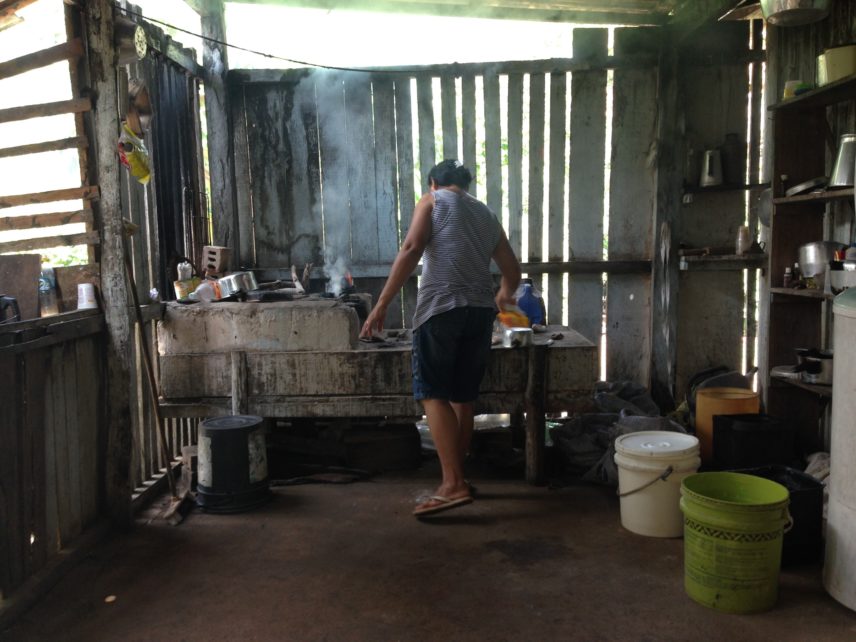
Flores and Conceição live in Brazilian cities separated by almost 2,000 miles, but their everyday lives are similar in many ways. Flores is 35 years old, married, and has 11 children, 8 of whom are minors. Before the pandemic, she performed cleaning and housekeeping services as a way of supplementing the family income, consisting of her partner’s salary and Bolsa Família, an income transfer program for low-income populations, of which Flores is a beneficiary. But since the pandemic began in March 2020, she has not been called on to perform any services, despite her attempts to work. Flores is solely responsible for the care of the home, the children, and for making food. She eventually received help from her mother, who lives in another neighborhood, and from her 12-year-old daughter (the only daughter among the children). Conceição is 36 years old, married, and has seven children, three of whom are her sole responsibility. Up to the beginning of the pandemic, she performed sporadic cleaning services, sold snacks, and worked as a cook at occasional parties. Like Flores, Conceição is a beneficiary of Bolsa Família and another municipal income transfer program. With the scarcity of complementary work for both women, donations of food and cleaning products made family subsistence possible, albeit in a very precarious way. In the case of Conceição, most of the financial expenses and care for the family and the home are her responsibility. In the case of Flores, her husband contributes the greatest amount of income to the household, but the money she receives from welfare programs is not much less than his salary.
In the first family, the core of the conflict is between Flores and her mother due to expectations about responsibilities, priorities, and ideal forms of care, especially toward the sick child. But tensions between husband and wife are also present, and these create and aggravate conflicts between mother and daughter. After 21 days in the hospital, despite sleepless nights, concern, and discomfort, Flores was asked to catch up on the accumulated chores at home: cooking meals, washing clothes, tidying up the house, giving attention to the children. In the second family, we also observe conflict between mother and daughter, especially as Andressa does not agree with how Conceição and her stepfather’s relationship develops. When she complains, she is accused of flirting with her stepfather, beaten up by her mother, and ends up deciding to leave the house. From Andressa’s perspective, her stepfather is violent, and neither helps with domestic chores nor fulfills his obligations as a father and provider. Despite Conceição’s serious suspicions against her, Andressa sees that her mother is overburdened, which has an impact on her health and well-being. Andressa also does not accept the fact that the care provided by her mother is limited to her younger siblings (care that she nevertheless considers appropriate) and to her stepfather (which seems unacceptable).
In both families, women are responsible for care. The inequality in the division of responsibilities results in an overload of work for women and in countless situations of conflict that can reach, in more extreme cases, fights, ruptures, and physical aggression. Flores’s and Conceição’s husbands did not have to say explicitly that sweeping the house, cooking, changing diapers, or taking care of the children are the tasks of their wives. They express this idea by not performing such tasks themselves. If some of these tasks are yet to be done both partners complain—sometimes, aggressively—with their wives. Furthermore, other women (mothers, neighbors, friends) hold Flores and Conceição accountable, openly accusing them of being “lazy” or gossiping and criticizing them. Since the beginning of the COVID-19 pandemic, Flores has observed that her husband spends more and more time away from home. In her view, this is his strategy for not having to deal with the “chaos” that the house has become: clothes scattered on the floor, children crying, accumulated dishes. What could be seen as proof of the need for collaboration has the opposite effect, resulting in the distance, even physical distance, of the spouse in relation to the domestic environment. Conceição‘s partner was dependent on her direct care for some time (including bathing and eating), due to a surgery. But, as Andressa remarks, he never acknowledged his wife’s help or proposed to contribute financially to the family’s livelihood. The care received is considered an obligation, as much as the other daily acts of care that she performed and from which he has always excused himself.
French philosopher Sandra Laugier’s proposal to understand care as a political principle that encompasses the domestic and public spheres leads us to another question: What is the role of public services, or the scarcity of these, in contributing to women being overloaded by the tasks of care? With the interruption of services such as schools and daycare centers since the beginning of the pandemic, children started to spend more time at home, demanding multiple levels of care: food, attention, and supervision during school tasks performed remotely and in conditions that are also precarious and unequal. The caring responsibilities that women hold, which were many even before the pandemic, become unsustainable with the suspension of public services, especially for those who have school-age children. The excessive demands exerted on women by their husbands and by other women in their social circle trigger situations of conflict, making care a thorny issue, full of tensions and sorrow.
The inequality in the division of responsibilities results in an overload of work for women and in countless situations of conflict.
The COVID-19 pandemic has intensified what sociologist and political scientist Charles Tilly, in his work on long-lasting, systematic inequalities in life chances, termed durable inequalities that greatly affect the everyday lives of those at the bottom of the social pyramid. For Tilly, asymmetric social relations (such as gender, for example) are incorporated into forms of government, and this makes them reproducible and durable. Public structures play a decisive role in women’s lives and it is also true that these structures reaffirm their responsibility for the care of their children, home, and family. Social policies around income distribution, from which our interlocutors benefit, require that the mother or woman or beneficiary report information on school attendance and the health of their children to social service units, which are part of the records generated on the mother’s behalf. The interruption of the state public services made this asymmetry of care not only more visible, but also inflammatory.
While writing this article, we learned that Conceição was diagnosed with a serious illness and one of her main complaints is that “she is going through all this alone,” without the help of her partner. In hospitals crowded with coronavirus-infected people, she has faced a real crusade in search of a diagnosis, exams, and the possibility of treatment. At the same time, she remains solely responsible for domestic care, for ensuring that children do their school lessons, and for financially providing for the family. Neither disease, pain, nor other physical restrictions attenuate Conceição’s role as caregiver. Regarding Flores, the latest news is that her husband left her home. Rather than serving as a relief, this situation presented new difficulties: with his departure, Flores’s responsibilities for supporting home and children increased overnight. Wellington did not offer many explanations about leaving. Flores does not necessarily consider that the unexpected separation was a result of the new domestic dynamics imposed by the pandemic, but she is keen to note that in one way or another responsibility for caring for the relationship was also an expectation placed on her by her husband. One of the few things he said to her was that “they were fighting a lot.” In other words, the responsibility for conflicts is also attributed to the women.